
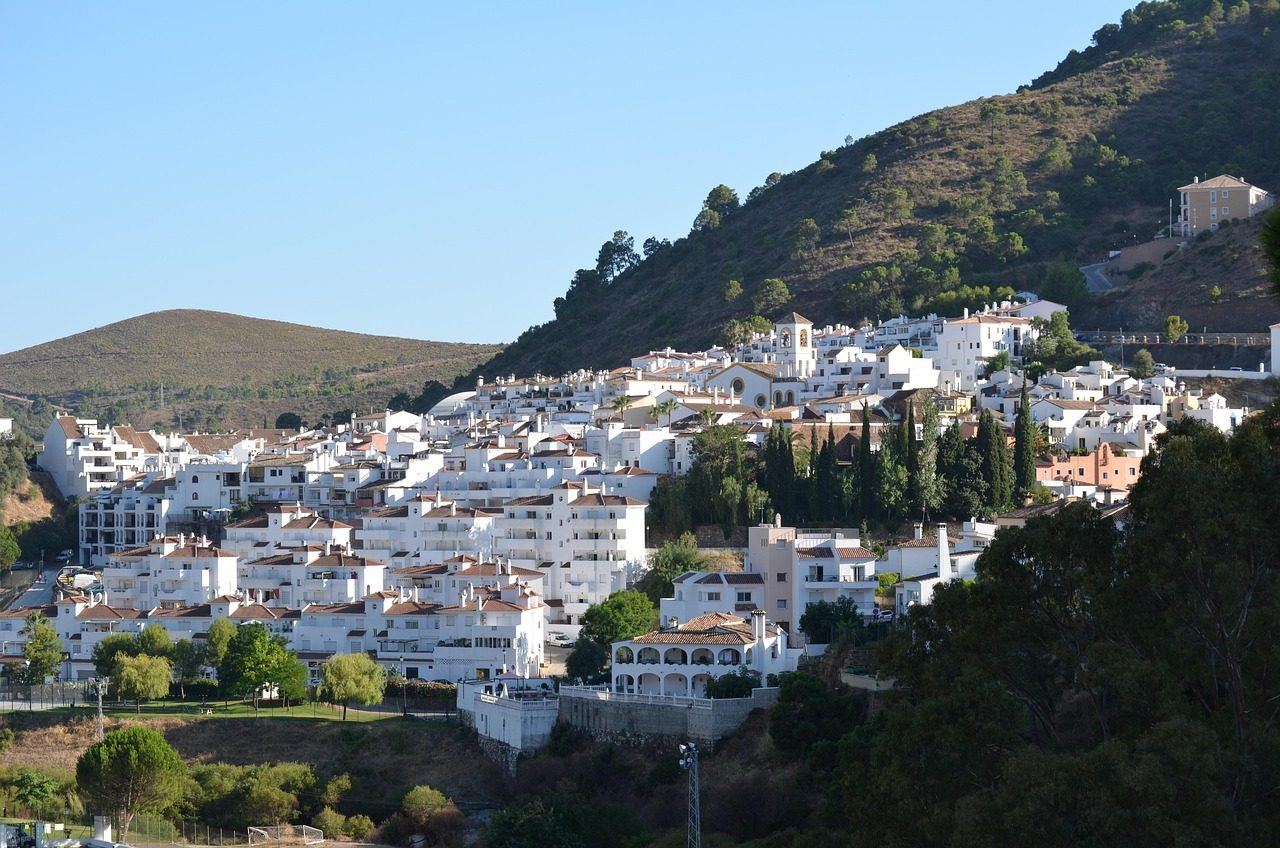
Most Alhaurín de la Torre owners we speak to think about their rental year in the same shape as a coastal landlord would: summer peak, autumn shoulder, quiet winter, Easter bump. They price accordingly. They block summer weeks for family, drop the rate from October, and accept that Tuesdays in February are dead weight. That mental model is the single biggest reason this town's holiday rentals under-earn their potential. Alhaurín de la Torre is not a beach town that happens to sit inland. It is an airport-corridor town with 372 registered VUTs, a working industrial estate, and a Monday-to-Thursday demand profile that almost no one is actively pricing for.
This piece is about that weekday layer. Where it comes from, who the guests actually are, why the new-build stock that dominates the town happens to suit them, and how we structure listings and pricing at the office in Arroyo de la Miel to capture business travel without losing the weekend leisure market that sits on top of it.
Why the calendar here doesn't behave like the coast
The first thing to understand about Alhaurín de la Torre is that there is no real off-season. We say this often and owners sometimes hear it as marketing language, but it is a structural observation about a specific town. Coastal markets like Fuengirola or Torremolinos are demand-shaped by sun-and-sea tourism, which has a clear seasonal curve even at the network's best year-round addresses. Inland pueblos blancos like Alhaurín el Grande are shaped by golf shoulder seasons and snowbird winters. Alhaurín de la Torre is neither.
What shapes demand here is proximity. The town sits roughly ten minutes from Málaga airport, fifteen from the city's western edge, and twenty from the seafront at Torremolinos. It hosts one of the larger working industrial estates in the western Málaga metro area. It is full of modern, post-2005 new-build apartment stock with lifts, parking, double glazing and air conditioning as standard. None of those features are seasonal. None of them swing with the August thermometer. The result is a flatter rate curve than anywhere else in our portfolio, with weekday demand that simply does not drop off the way it does on the coast.
The owners who do well here are the ones who internalise this and stop trying to mimic coastal calendars. The owners who underperform are the ones treating mid-November Tuesdays as unbookable when in fact those nights are some of the most reliably bookable nights of the entire year — they are just bookable at a different price point, to a different guest, for a different reason.
The Polígono Industrial demand layer
The Polígono Industrial sits on the western flank of the town and houses logistics operators, light manufacturing, distribution warehouses, automotive suppliers, food processing, and a thick layer of service businesses feeding all of the above. It is not glamorous and it is not visible to anyone who arrives at the town from the residential side. But it generates a steady, mostly invisible flow of business travellers who need somewhere to sleep within a five-minute drive of their meeting or audit.
These travellers do not, in general, book the hotels in Málaga city. The math is wrong for them. A two-week project at a logistics client in the polígono with a hotel in Málaga Centro means twenty-eight one-way drives across the airport approach roads at rush hour, plus parking, plus dinner in a city they did not come to see. A holiday rental in Alhaurín de la Torre means a five-minute drive each way, a parking space included, a kitchen for the evenings they cannot face another restaurant, and a washing machine for the second week.
The profile is consistent across the year. Engineers commissioning equipment for a one-to-three week project. Auditors from headquarters in Madrid, Barcelona, Lyon, Stuttgart or Milan. Trainers running a fortnight of operator certification. Regional managers doing extended site visits. IT integrators on a SAP rollout. None of these guests want a stag-friendly seafront apartment. They want a quiet bedroom, a desk, a stable wifi connection, a kettle, and to be left alone Monday to Thursday.
This is where the new-build stock that dominates the town earns its keep. The 2010-2020 apartment blocks that owners sometimes apologise for ("it's a bit characterless") are exactly what this guest is looking for. Neutral palettes, USB sockets next to the bed, induction hobs, fitted wardrobes, a balcony with a parking space below. The "characterless" critique is a leisure-market critique. The business traveller doing a three-week commissioning project does not want character. They want a functioning routine.
The airport-corridor overlay
On top of the polígono demand sits a second weekday layer that is harder to see but just as real: the airport corridor itself. Málaga airport sits ten minutes north, with all that implies. We see four distinct sub-segments inside this overlay through the rental year.
The first is airline crew on irregular rotations, particularly low-cost carrier crew based at Málaga who do not want a long-term lease in the city. The second is consultants flying in for two to four nights at a time to clients headquartered in Málaga city or the technological park at Campanillas, who choose Alhaurín de la Torre because it is quieter, has parking, and is the same drive time as a city-centre hotel without the city-centre traffic. The third is auditors and inspectors at the airport's logistics partners and at the various aviation-adjacent businesses that have grown up around the airport perimeter. The fourth, smallest but most consistent, is medical and pharmaceutical reps covering a Málaga province territory who want a base that lets them reach Antequera, Marbella, the Guadalhorce valley and the city itself within forty minutes.
None of these segments book through the channels that owners watch. They are not browsing Booking.com on a Friday night looking for a sea-view balcony. They are booking through Airbnb's longer-stay filters, through corporate travel platforms, through repeat direct contact after a first stay went well, and through word-of-mouth inside the company. They book Monday-to-Thursday or Sunday-to-Thursday. They pay weekly. They almost never book weekends.
What the weekend looks like, and why it matters
The mistake we see owners make is treating weekday and weekend as if they were one market with one price. They are not. The weekend in Alhaurín de la Torre, particularly between May and October, is a different product entirely. It is Málaga-city overflow demand: families and couples who could not find or could not afford accommodation in the city for a weekend break, who choose Alhaurín de la Torre because they can drive into the centre in twenty minutes and back out without paying central parking rates.
That weekend market is leisure. It pays a different rate. It wants different things: pool access, a sociable terrace, restaurant recommendations, a sense that the host knows what is going on locally. It books two to four nights, almost never longer. It is concentrated Thursday-evening to Sunday-afternoon. And it sits naturally on top of the weekday business layer, because the two markets do not want the same nights.
The opportunity, which owners routinely miss, is that these two markets can be priced and marketed independently within the same property. A flat year-round nightly rate is leaving money in both directions: too high for the weekday business traveller who would otherwise commit to a two-week stay, and too low for the weekend Málaga-overflow family willing to pay for a peak Saturday night in mid-September.
We address this in the income modelling work we do during owner onboarding. The same one-bedroom apartment in a modern block can show very different annualised numbers depending on whether the strategy is "one flat rate, hope for the best" or "differentiated weekday and weekend pricing with mid-stay discounting baked in". The difference, for a stabilised property at full year occupancy, is not marginal.
Pricing the mid-stay correctly
The hardest part of capturing the polígono and airport-corridor layers is pricing the mid-stay correctly. A business traveller booking a two-week commissioning project is not comparing your nightly rate to a hotel's nightly rate. They are comparing your two-week total to their per-diem allowance, to the friction of booking and expensing a hotel for fourteen consecutive nights, and to the comfort delta between a hotel room and a one-bedroom apartment with a kitchen.
The right structure is almost always a meaningful weekly discount and a further monthly discount layered on top. We typically build these into listings at fifteen to twenty per cent for weekly stays and twenty-five to thirty-five per cent for monthly stays, with the exact figures calibrated to the property's weekday baseline and the time of year. The point is not to give the property away. The point is to make the booking obvious for a guest who is doing a quick mental calculation against a hotel and a per-diem.
What you get back, for the discount, is the thing that matters most: nights filled in the periods when nightly leisure demand simply does not exist. A two-week corporate booking in the second half of January is not displacing anything. It is converting nights that would otherwise sit at zero euros into nights at a sustainable mid-stay rate. Our estimator work for new owners now routinely models a mid-stay layer at fifteen to twenty per cent of total annual nights for the right kind of property, which for Alhaurín de la Torre means modern, well-parked, professionally photographed, and presented as work-friendly rather than party-friendly.
What the listing actually needs to say
If you want to capture this guest, your listing needs to say so. The default Costa del Sol listing template — sun, sea, sangria, beaches "a short drive away" — is the wrong product positioning here. The polígono guest scrolls past it without registering.
The listing that converts the weekday traveller emphasises different things. Real wifi speed numbers, ideally measured and screenshot, not a vague "fast wifi" claim. A photograph of the desk or workspace, including the chair, taken at desk height and not from across the room. Parking explicitly described as included and accessible, with the distance from car to apartment door stated. Distance from the polígono and from the airport, in driving minutes, with a generic phrasing about the airport corridor rather than naming specific roads in a way that dates the listing. Mention of an iron, a washing machine and a hairdryer, because the business guest checks for these and the leisure guest assumes them. A reference to the kitchen being functional for evening meals — frying pan, basic spices, a sharp knife — rather than just photogenic.
We also recommend a short separate section in the listing description aimed explicitly at longer stays. Something that signals to the corporate booker that the property is set up for two-week and four-week stays, that early check-in or late check-out is workable on the polígono's typical Monday morning and Thursday evening schedule, and that weekly cleaning is available. None of this scares off the weekend leisure booker, who reads past it. All of it converts the business booker who would otherwise scroll on.
The regulatory piece nobody mentions
There is one regulatory wrinkle worth flagging, because it sits underneath all of this. A meaningful share of the longer stays we just described tip across the line that distinguishes a holiday rental from a different legal product. Stays beyond a certain duration, or stays where the guest is clearly using the property as a primary base for work rather than a tourist stay, fall outside the VUT regime entirely and into the regime governing seasonal or temporary residential lets.
This matters for two reasons. First, your VUT obligations — guest registration, the tourist tax submissions, the platform reporting — apply differently depending on which regime the booking sits under. Second, the tax treatment of the income is different. Owners running these mid-stays casually under their VUT licence are usually not capturing the full implication of what they are doing, and in a town with 372 registered VUTs sitting under a Junta enforcement framework that has become measurably more attentive over the last eighteen months, casual is not the right posture.
We work through the licence question with owners during onboarding rather than after, because retro-fitting a compliance structure to an existing pattern of mid-stay bookings is harder than designing it correctly from the start. The VUT licence page on this site walks through the basic framework. For Alhaurín de la Torre owners specifically, the conversation we end up having is almost always about which proportion of the year sits cleanly under VUT and which sits under temporary residential, because that ratio determines what gets reported where.
What this looks like at portfolio level
When we model an Alhaurín de la Torre property properly — meaning we price the weekday and weekend layers separately, build in a real mid-stay discount structure, position the listing for the business guest as well as the leisure guest, and handle the licensing distinction cleanly — the annualised picture looks materially different from a default flat-rate strategy. Occupancy ticks up because nights that were previously empty are now filled by the corporate layer. Average nightly rate dips slightly because the mid-stay discounts pull the blended figure down. Revenue rises because the occupancy gain more than offsets the rate concession. Wear and tear, interestingly, often improves, because mid-stay corporate guests are typically lower-impact occupants than weekend leisure parties of six.
This is the work behind our services for owners in this town specifically. The pricing model is different here. The listing copy is different. The guest screening leans differently. The cleaning and linen rotation is structured around weekly turnovers rather than every-three-days. Even the welcome pack is different — fewer beach towels, more local supermarket and dry-cleaner information.
If you own an apartment in Alhaurín de la Torre and you have been treating it like a beach rental that happens to be ten kilometres inland, the income table is probably telling you that the strategy is not quite working. The town has its own demand structure, and the structure rewards owners who design for it. Come and talk to us at the office in Arroyo de la Miel — the conversation starts at /for-owners/#contact, and the first thing we will do is look at your last twelve months of bookings and tell you, honestly, where the weekday layer is sitting and what it could be.